Read together
Who is Durga Maa?
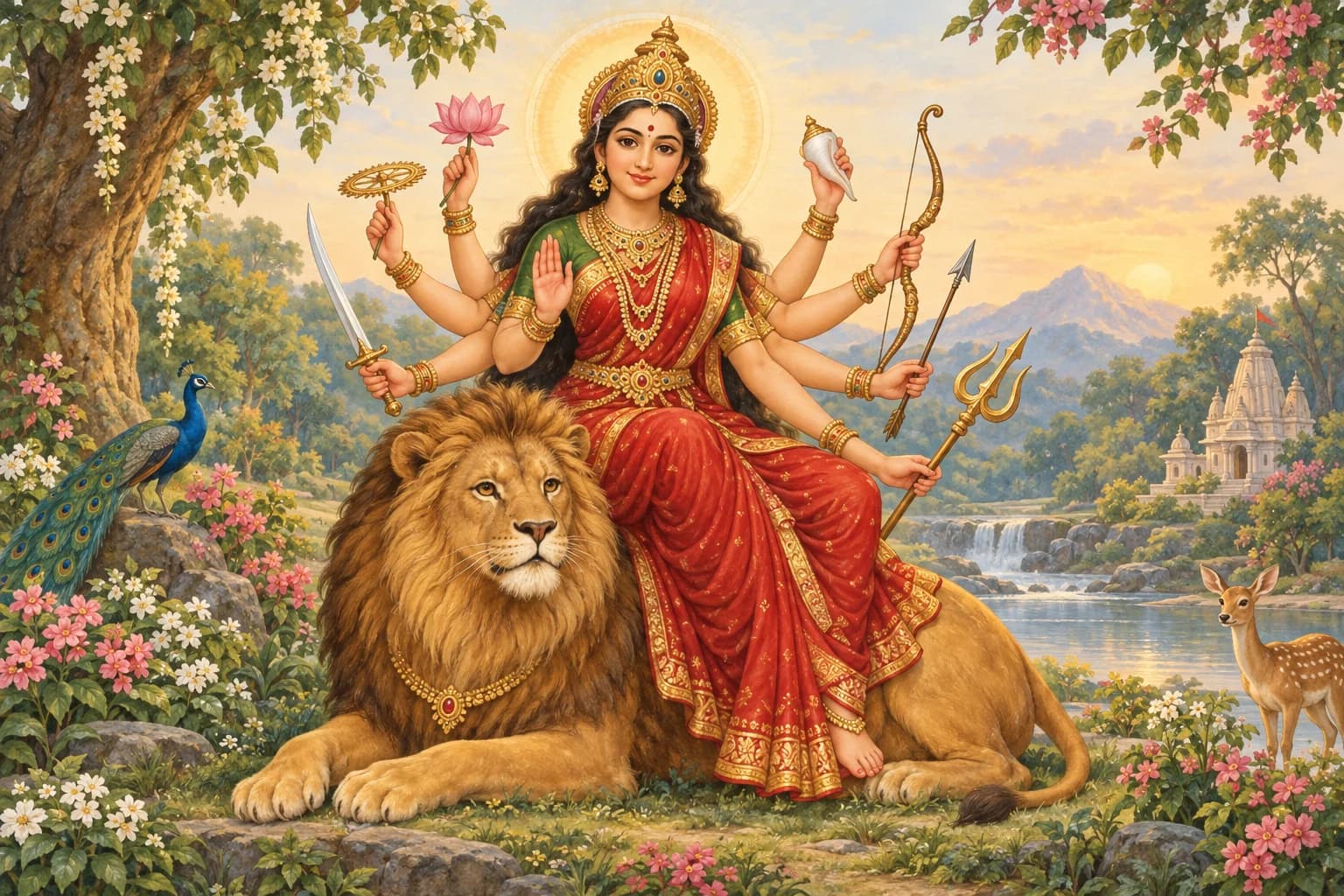
A lion, a steady face and many hands holding different objects: an image of Durga Maa gives us a lot to notice. Hindus worship her as a powerful form of Devi, the Goddess. In her well-known encounter with Mahishasura, her strength protects the world from a destructive ruler. This is a short introduction to that sacred image and its meaning, rather than a telling of every battle.
Devi means Goddess, and Maa is a loving way to say Mother. This guide begins with Durga Maa. The library also introduces Saraswati Maa and Lakshmi Maa, whose images open different conversations about learning and prosperity. Take time with each introduction rather than assuming that every name, picture and family custom has one identical explanation.
Strength that protects
The Devi Mahatmya celebrates Durga’s victory over Mahisha, the buffalo demon. In this account, the gods cannot overcome him; their combined divine energy takes the form of the Goddess. They give her weapons, and she defeats him. The story honours the power of Devi. It also invites a question we can discuss together: what is strength being used to protect?
Her many arms make that divine power visible. A trident can recall Shiv Ji’s gift, and a discus can recall Vishnu’s. The lion is her mount. These are details of sacred art, not instructions for children to carry weapons or copy a fight. Begin by naming one thing you see; a grown-up can help you discover the story behind it.
Why do images and celebrations differ?
There is no single arm count for every Durga image. For example, a twelfth-century sculpture in the Metropolitan Museum of Art has sixteen arms. Other artists show different forms. During Navratri, some communities honour nine forms of Durga; others honour Durga, Lakshmi and Saraswati. Ask which tradition a particular picture or celebration belongs to before deciding that another one is wrong.
A useful family question is, “What does our home or community do during Navratri?” Someone may remember a song, a gathering or a particular image. Listen to the example and name whose practice it is. Learning about your own family and respecting a different family’s practice can happen together. Our Navratri guide offers a place to continue.
What can courage look like today?
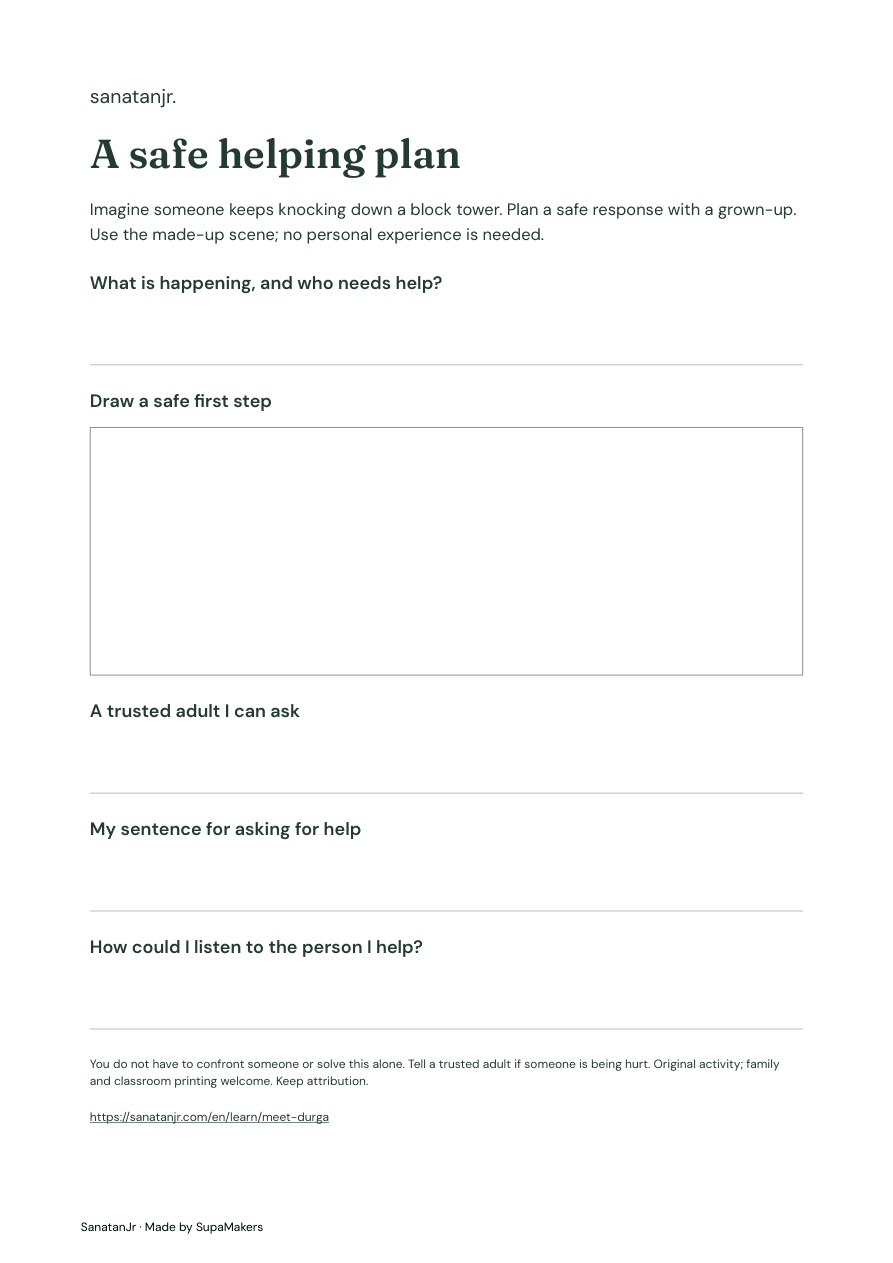
Now imagine a small everyday scene. Two children are building with blocks when someone repeatedly knocks their work down. One child feels angry; the other becomes quiet. Our example is not an episode from scripture. It is a chance to think about a protective response: name what is happening, move away if necessary, and ask a trusted adult to help stop it.
Courage can sound like, ‘Please stop. We are still using those.’ It can also mean standing beside the child who is upset and going together to a grown-up. You do not have to win an argument or face a frightening situation alone. A helpful action should make people safer, rather than begin a new fight.
Help includes listening
After the problem has stopped, care can continue. Ask whether the children would like help rebuilding or would prefer a different activity. Listening to their answer matters. In the plan below, choose one action you could actually take and one person who could help. The aim is to turn a thoughtful idea into something useful.
Helping does not mean deciding everything for the other person. You can ask, “Would you like me to sit with you, help rebuild, or find a grown-up?” They may want something different from your first idea. If someone is being hurt, involve a trusted adult; a child does not have to solve the whole problem or keep it secret.
Make a safe helping plan
For the activity, use our imaginary block-building problem. Name what happened, draw a safe first step and practise a sentence for asking an adult for help. The free sheet below keeps these ideas together. You may speak while a grown-up writes, and you can change a plan that does not feel useful. No one has to share a private experience.
After meeting Durga Maa, read about Navratri or explore ahimsa, the effort to avoid harm. You can also meet Saraswati Maa and ask what patient learning looks like. These are connections for another family session. A small conversation, a clear question and one caring action are enough for today.