Read together
Who is Saraswati Maa?
Think of something you are learning: a new word, a rhythm, a drawing or how to explain an idea. Hindus honour Saraswati Maa as the Goddess of knowledge, learning, music and the arts. A school lesson and a creative afternoon can both give a family a starting point for learning about her.
Begin with one question: what would you like to understand or make? A child who enjoys stories may choose a word, while someone else chooses a tune or a shape. Saraswati Maa’s connection with learning makes room for that conversation. Nobody has to arrive with a finished skill before joining in.
Notice a symbol, ask a question
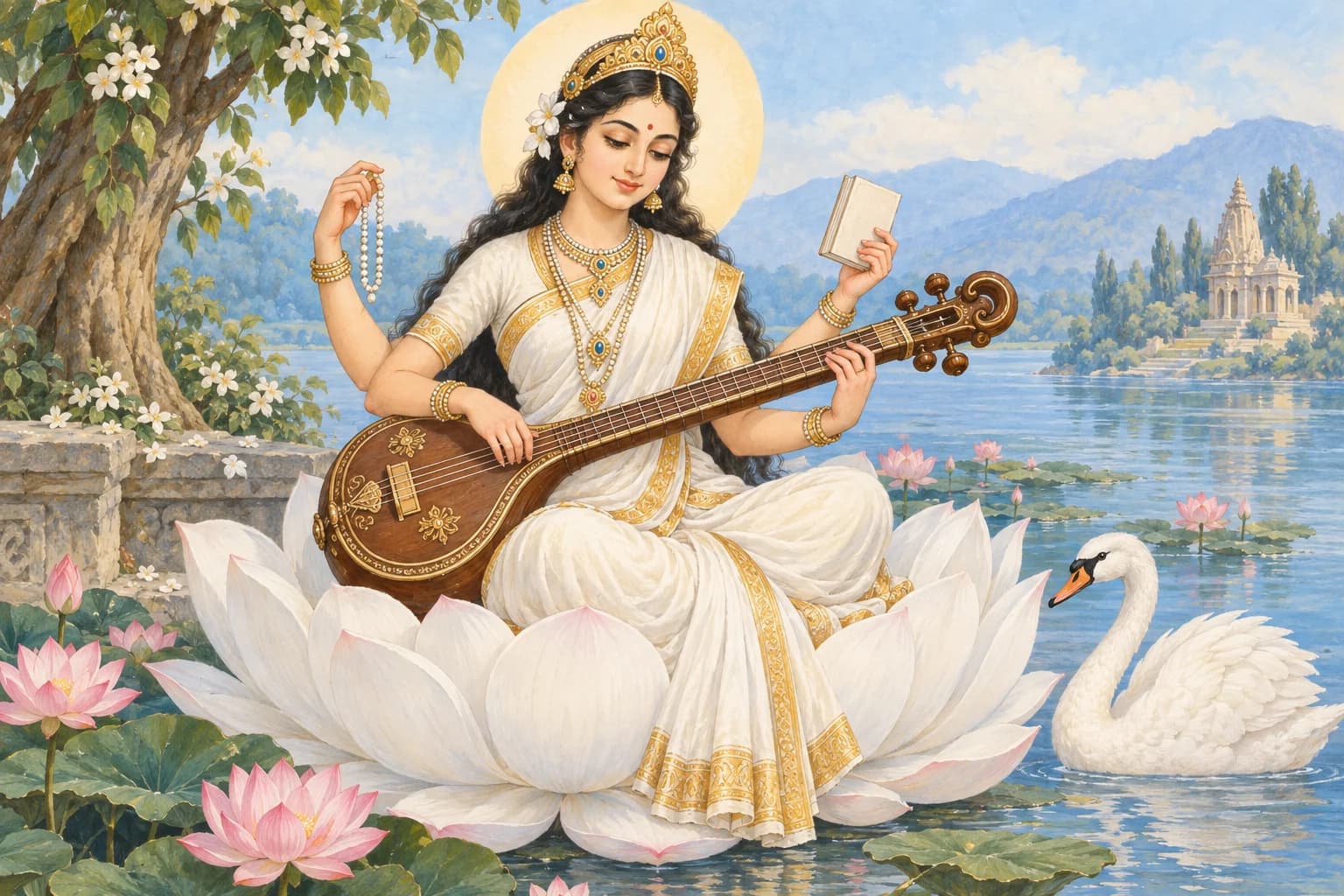
Look for the veena, a stringed musical instrument, in her image. It points to music and the arts. A book represents knowledge; prayer beads, called a japa mala, can represent concentration and discipline. In HAF’s explanation, the instrument also invites us to think about harmony. Start with these few details instead of trying to memorise every symbol at once.
An image is a good place to ask how we know something. You can see strings on an instrument; learning that it is a veena may require a caption or a knowledgeable person. Name the source of that explanation. Another artist may choose a different pose or arrangement, so look carefully before expecting every image to match.
Learning and celebrations
Vasant Panchami is one celebration dedicated to Saraswati. You may also hear it called Basant Panchami. In many celebrations, people wear or display yellow, and schools hold prayers connected with learning. Some Navratri traditions also honour Saraswati. A family’s way of marking these occasions can differ from a neighbour’s; ask what the day means to them.
A celebration can also open a conversation about who helps us learn. Ask a relative about a teacher, a library book or a song they remember. Record whose memory it is. Learning about one family’s Vasant Panchami or Navratri does not tell us how every Hindu family celebrates; keep space for another answer.
Listen and create together
Here is our own way to explore that idea. Imagine two people clapping a rhythm together. If both race ahead without listening, they may lose the pattern. When one slows down and leaves space for the other, they can find a shared beat. Listening changes what they make together. This is a learning example, not a story about how the Goddess created music.
For example, draw a line of three circles and ask a partner to notice the pattern. You might change their size or spacing on your next attempt. If you choose a rhythm instead, you can tap softly, point to marks on paper or let someone else make the sound. These are different ways to take part in the same shared practice.
When practice feels difficult
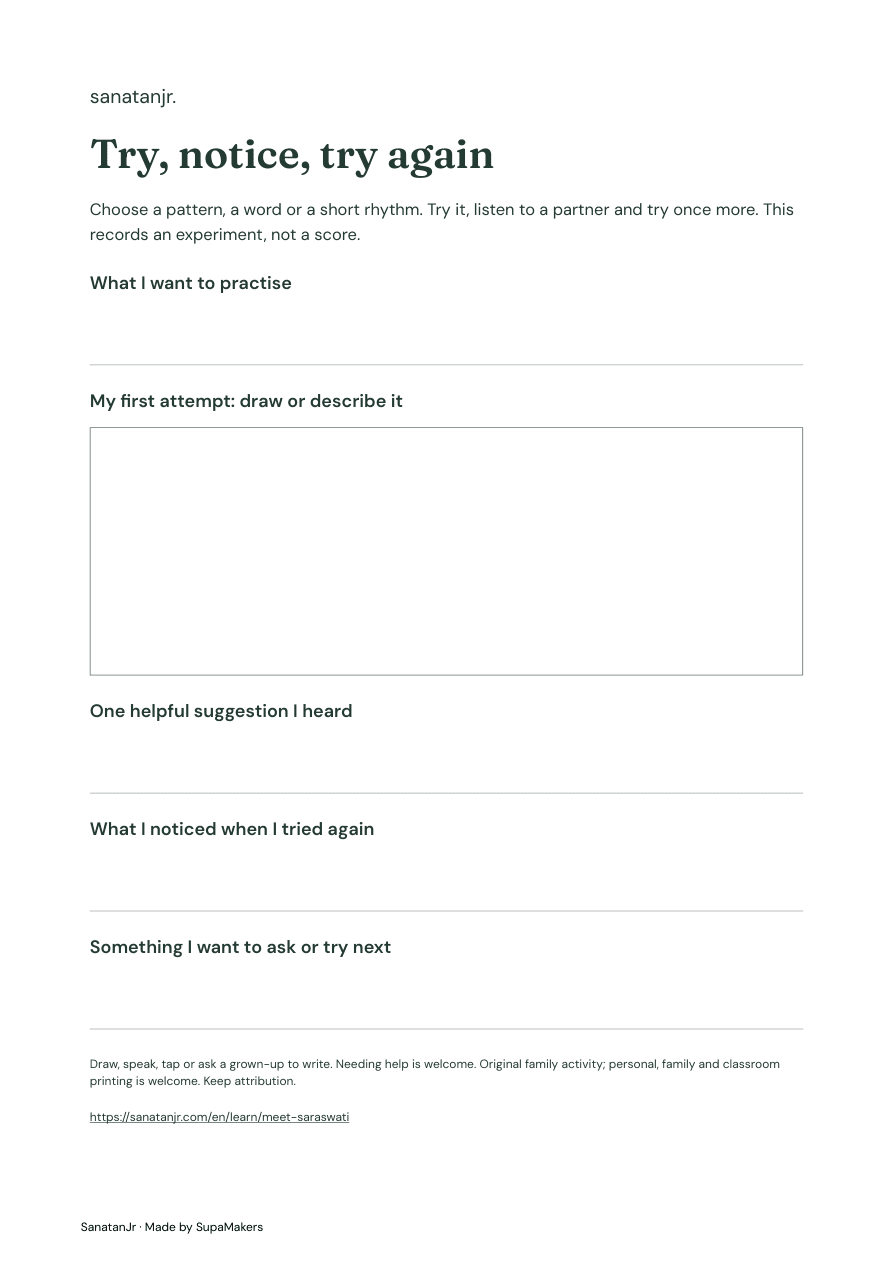
A difficult first attempt is still an attempt. Perhaps your line wobbles, a word is unfamiliar or your rhythm comes out differently from the one you heard. Choose one small part to try again. You can ask for an example, take a break or use a different way of practising. Learning does not have to become a contest with the person beside you.
Families may pray for Saraswati Maa’s blessings as they begin studying or making art. Prayer can be part of that family’s devotional life; a test result does not measure a child’s devotion or worth. Questions, practice and support from others still have a place. Tell a grown-up when you need something explained in another way.
Keep a small learning record
For today, make something small enough to finish: a three-beat rhythm, a drawn pattern or one carefully chosen word. Share it with someone who will listen. Ask them to notice one detail, then exchange roles. Finish by naming what you enjoyed discovering, not by deciding whose work was best.
The worksheet is a record of an experiment, not a report card. Draw or describe the first attempt, name one useful suggestion and notice what happens when you try again. “I still need help” is a useful observation too. Keep the sheet if you would like to return to the idea; there is no need to repeat it until it is perfect.