Read together
A difficult answer
Bharata had come to see Rama with a hope that mattered deeply to him: his elder brother would return to Ayodhya and rule. Rama was living in the forest, keeping the promise that had led to his exile. Bharata did not want the kingdom as a prize for himself. He wanted the person he believed should lead it to come home.
He spoke earnestly about the people waiting for Rama and about his own uncertainty. How could he manage such a large kingdom alone? The task seemed greater than he could carry. Bharata’s love for his brother and his worry for Ayodhya were both present in that appeal.
Rama listened with affection. He believed Bharata had the understanding and training to govern well. He also reminded him that governing did not have to mean knowing every answer alone: wise ministers and advisers could help. But Rama would not abandon his father’s promise. The answer Bharata had hoped for would not come that day.
Something to carry home
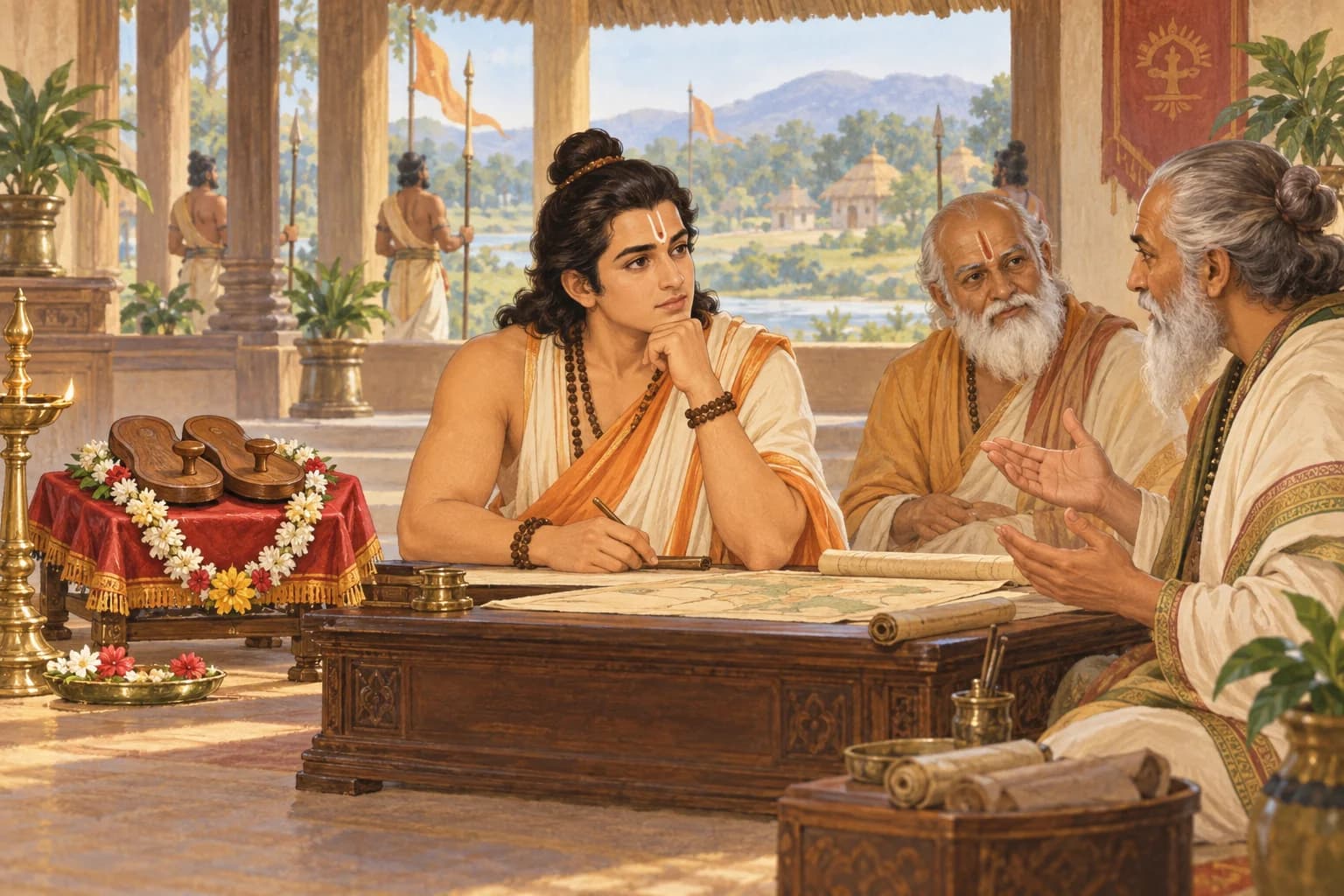
Then Bharata asked Rama to place his feet on a pair of wooden sandals. These were padukas, sandals that would become a sign of Rama’s authority. Rama stood on them and gave them to his brother. Bharata received them with reverence. They were small enough to carry, yet they represented a responsibility much larger than themselves.
The brothers said farewell with affection and sorrow. Bharata would take the sandals back, while Rama would remain in the forest until the exile was complete. The plan had changed, but Bharata’s devotion had not ended. He now had to turn his love for his brother into care for the people who were still waiting.
After returning to Ayodhya, Bharata spoke with Vasishta and the elders about living at Nandigrama. They agreed. He travelled there with Shatrughna, accompanied by ministers and others. The sandals went with him. He was leaving the city for a simpler dwelling, but he was not putting aside the work of government.
The work of waiting
At Nandigrama, Bharata placed the padukas in the royal seat and honoured them beneath the state canopy. He explained that the kingdom had been entrusted to him on Rama’s behalf. The sandals made that trust visible: he was caring for something he intended to return, not treating it as a possession to keep.
Bharata worked with his ministers, bringing matters of the kingdom before the sandals and then attending to them. The Ramayana describes even small affairs receiving this care. Waiting was not an empty stretch of time. There were people to serve and decisions to make while Rama was away.
The pair of sandals did not do Bharata’s work for him. They reminded him why he was doing it. When the time came, he hoped to return them and the kingdom to Rama. Until then, devotion meant showing up for the responsibility in his hands, with the help of people he could trust.