Read together
Who is Hanuman Ji?
Hanuman Ji is a Hindu deity and a devoted companion of Shri Ram in the Ramayana. He is remembered for courage, loyalty, knowledge and service. The epic tells of his help in the search for Sita Maa and his extraordinary journeys. Devotees honour him with love and reverence. His place in these traditions is much richer than being the strongest figure in an adventure.
The word bhakti means devotion: a loving commitment to the Divine. Seva means service. These words help us talk about why Hanuman Ji acts, as well as what he can do. For a first introduction, keep one question in mind: how does he use his abilities to help? You can ask that question while looking at an image, reading a story or listening to someone explain their family's traditions.
Recognise the figure
Hanuman Ji is one of the vanaras in the Ramayana. His monkey-like face and long tail often help us recognise him in art. Artists also give him a human-like body, clothing and ornaments. The Met's ‘Hanuman Conversing’ sculpture shows him engaged in a respectful exchange with Shri Ram. That artwork helps us notice a less dramatic quality: a thoughtful conversation can be worth remembering alongside a great leap.
In our illustration, Hanuman Ji joins his hands in reverence. A gada, or mace, rests beside him. Sacred pictures may show him standing, kneeling, speaking or carrying something; no single pose appears in every image. Start by describing the hands, face and objects. Ask a grown-up what the particular picture represents. A weapon in a traditional image is not an invitation to swing a heavy object or frighten someone.
A mountain and a message
A mountain in Hanuman Ji's hand points towards a well-known healing episode. In our linked reading, he goes to bring medicinal herbs and returns with a mountain when he cannot identify what is needed. It is an extraordinary event in a sacred story, not a lesson in choosing wild plants. Children should bring worries about illness or injury to a trusted grown-up rather than trying to imitate the episode.
Another important part of his work is carrying news and making contact. In the Ramayana he helps connect people who are separated. Being a messenger takes care: listen to what matters, understand whom the message is for, and explain it clearly. You do not need a long journey to try that skill. You could repeat a simple instruction to your grown-up and check together whether you understood it.
Strength includes listening
When Hanuman Ji approaches Shri Ram and Lakshmana in Valmiki's Kishkindha Kanda, he speaks as Sugriva's messenger. Shri Ram notices the care and learning in his speech. This part of the story gives us another way to think about strength. Knowing how to speak, ask and listen can help solve a problem that muscles alone cannot solve. Our separate meeting story gives the encounter room to unfold.
Imagine someone is carrying a pile of books. Grabbing the books immediately might make them fall. Asking, ‘Would you like help, and which ones can I carry?’ gives the person a choice and helps you understand the task. This is our everyday reflection on helpful strength. It is a small example for family discussion, not a quotation from the Ramayana or a test of anyone's devotion.
Choose a connected story
Begin with Hanuman Ji's meeting with Shri Ram if you want a story about a careful first conversation. Then read about Mainaka, the mountain who offers hospitality during a journey. That story has selected English and Hindi video companions on its page. Compare how Hanuman Ji receives kindness and responds to it. You can pause after one story; a short, attentive session is enough for today.
The healing-mountain story explores trying another way when a task is difficult. Its family note explains the battle setting while the reading focuses on care. Different Ramayana traditions expand episodes differently. If a video includes extra scenes, its parent note can help you understand the difference. A familiar title does not mean that a text and a film tell exactly the same version.
Make a helping plan
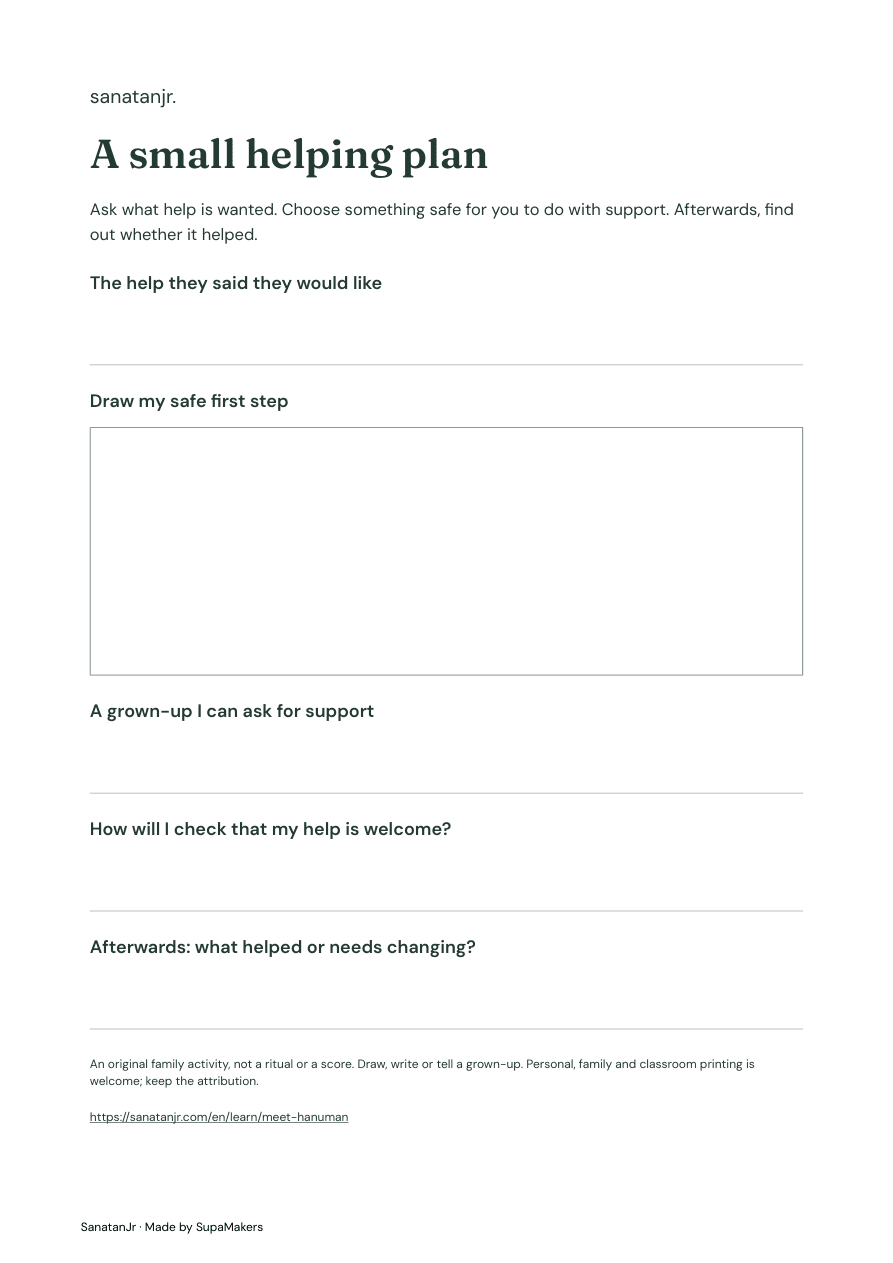
On the ‘A small helping plan’ sheet, choose one ordinary situation at home or in class. First ask what help is wanted. Draw a safe first step, decide what you can do and name a grown-up you can ask if the task becomes difficult. Helping should fit your abilities. You do not need to lift something heavy, stay awake when tired or handle a risky task to show care.
After trying the plan, ask the other person whether your help was useful. Perhaps listening was enough, or perhaps you needed to change the plan together. Share one thing you learned and one question about Hanuman Ji that you still have. Courage can include admitting you do not know something. In a family reading, questions are welcome and nobody needs to pretend to have every answer.