Read together
Who is Ganesh Ji?
Ganesh Ji, also called Ganesha or Ganapati, is a Hindu deity easily recognised by his elephant head. In widely told traditions he belongs to the family of Shiv Ji and Parvati Maa. Many devotees remember him before beginning something important and worship him as a remover of obstacles. A family might hear his name at the start of worship or a new undertaking. Different homes have their own ways of doing this.
An introduction does not have to begin with memorising every name. Start with what you notice, then ask what a story or a knowledgeable grown-up can explain. Ganesh Ji is a sacred presence for devotees, not simply a character with an unusual appearance. You can approach an image with both curiosity and respect, whether the picture is familiar to you or you are seeing it for the first time.
Look closely at the image
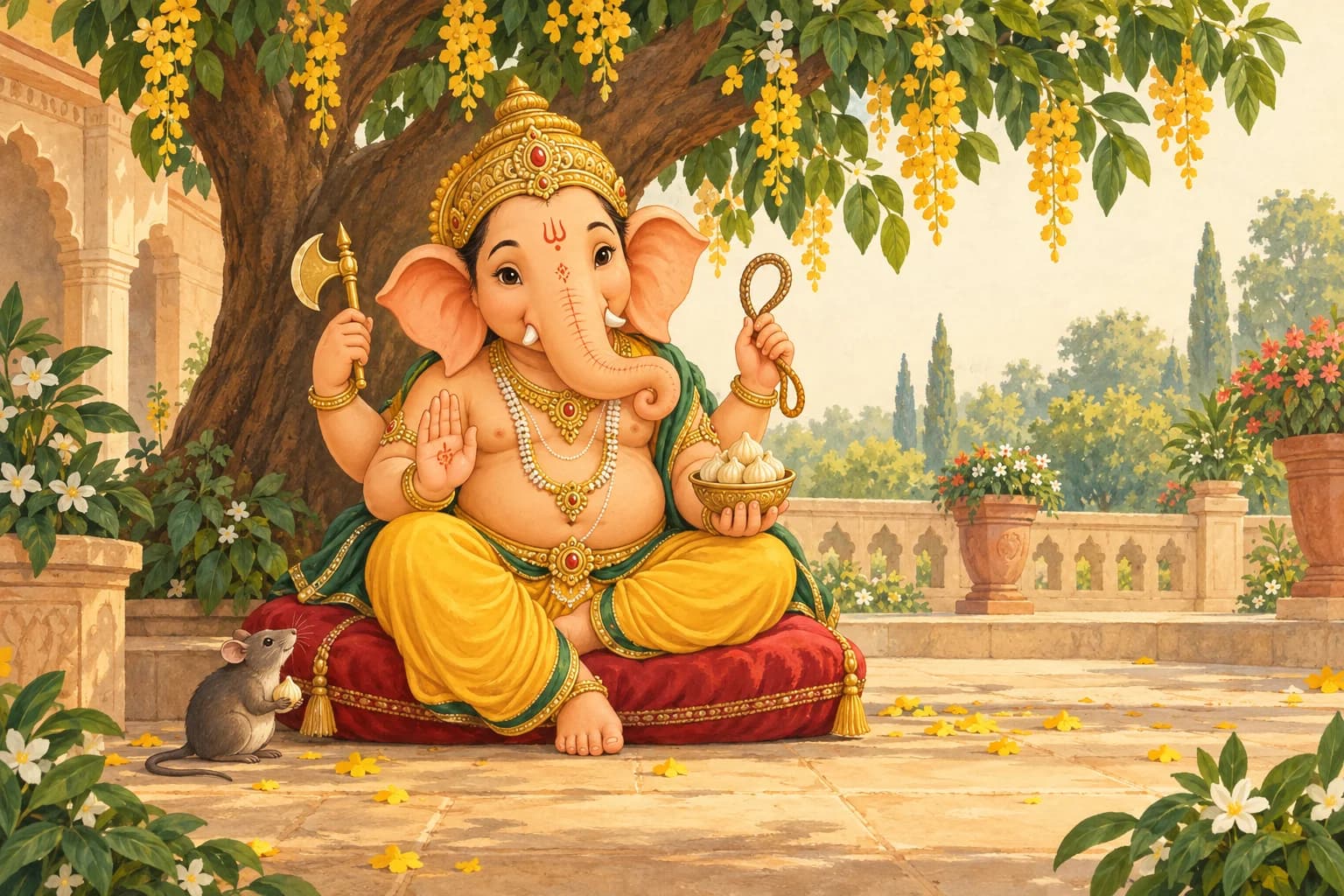
The elephant head, trunk and broad ears are useful features to recognise. Many images also show a rounded belly and several arms holding different objects. In the Norton Simon Museum's explanation of one four-armed sculpture, the extra arms express a divine nature. They are part of sacred art, rather than a drawing lesson about how a human body works. Look carefully at the particular artwork instead of expecting every picture to match.
Why does Ganesh Ji have an elephant head? There are different traditional accounts. A well-known account involving Parvati Maa and Shiv Ji includes frightening events, so a grown-up can choose when and how to explore it with you. This page is a first introduction, not a retelling of that origin. If you see one shortened tusk, that too can lead to more than one story; an image alone does not tell you which account its artist had in mind.
Sweets, a mouse and different forms
Look for a bowl or a sweet in a hand. Artists often include sweets among Ganesh Ji's attributes. In our illustration the bowl contains modaks; other artworks may show different treats. You can describe the shape you actually see before naming it. A picture of food in sacred art is a detail to understand, not a rule about what you must bring to a temple or eat at home.
A small mouse or rat is often shown near Ganesh Ji as his vahana, or vehicle. The National Crafts Museum has a seated figure with a rat near its foot. Other images show him standing or dancing. These variations are a good reason to ask, ‘What is the same, and what is different?’ A family may offer a symbolic interpretation, but it is better to name that interpretation than to pretend every artist used one fixed meaning.
What is an obstacle?
An obstacle is something that makes a task difficult. It might be a missing piece in a puzzle, an instruction you do not understand or a plan that needs changing. Remembering Ganesh Ji before a beginning can be an expression of devotion. Our everyday reflection is to make room for thought: what is the difficulty, what could help, and who can you ask? This reflection is an activity suggestion, not a promise that every difficulty disappears.
Imagine you want to make a welcome card but cannot decide what to draw. You could rush, stop altogether, or ask the person what colours they enjoy. Then try one small sketch. Starting thoughtfully does not mean knowing the whole answer already. It can mean listening, asking for help and being willing to change the plan. Your grown-up may have a different example of a beginning that took patience.
Begin with a story
In our story of Ganesh Ji's journey around the world, a question receives an unexpected answer close to home. Read the complete story together and notice what the family means to him. Then ask whether understanding a question can matter as much as moving quickly. The reflection belongs to that story; it does not mean that every real journey can be replaced by staying in one place.
The story of Ganesh Ji and Kubera offers another conversation: what makes a welcome generous? If you are curious about a celebration, our Ganesh Chaturthi guide explains the festival separately. A deity introduction, a story and a festival guide answer different questions. Choose the one you need today, and leave the others for another family session. There is no list you must finish before you belong in the conversation.
Make your own beginning
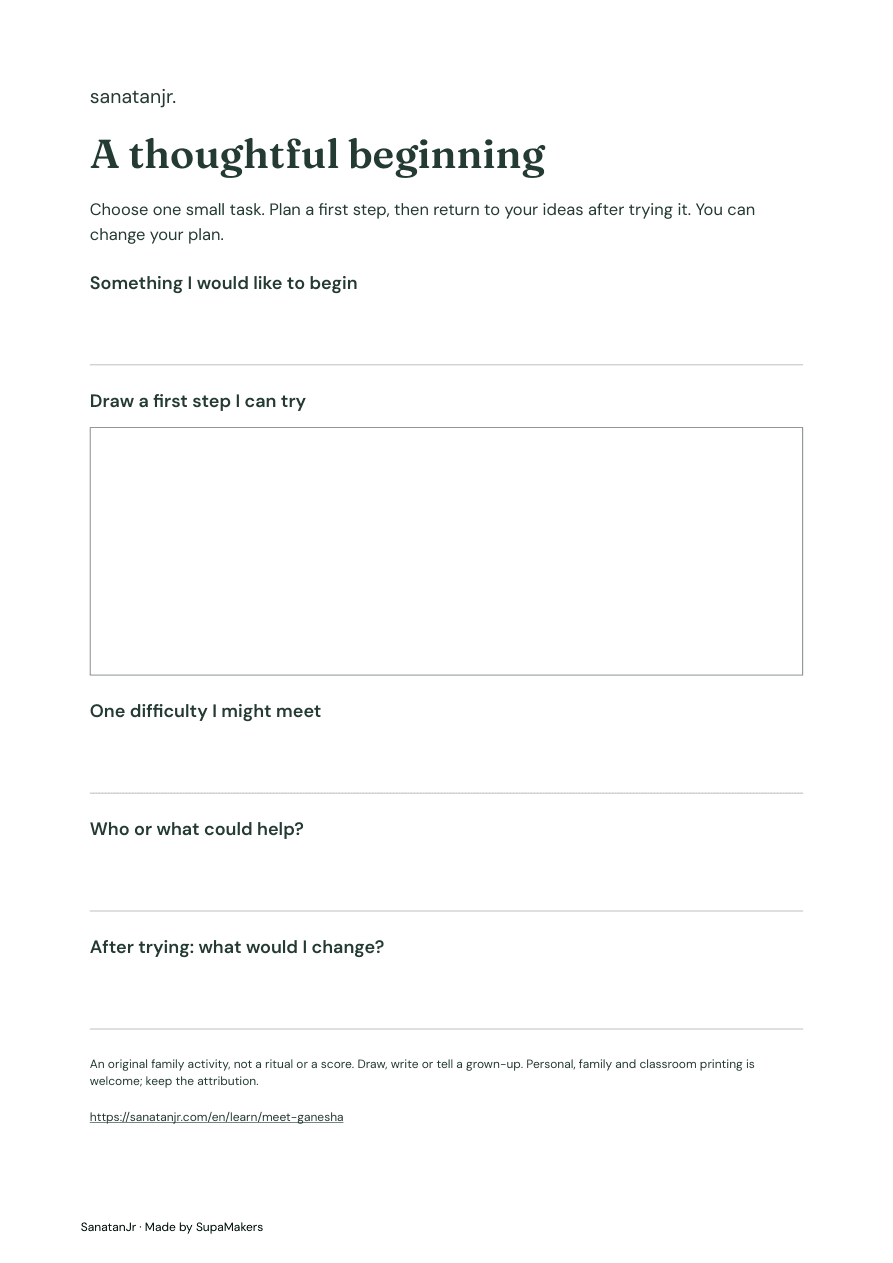
Try the ‘A thoughtful beginning’ sheet with one small task of your own. Name the task, draw your first step and describe one possible difficulty. Decide who could help and what you might try next. You can tell your answers to a grown-up instead of writing. The point is to make a useful plan, not to produce the neatest drawing or the longest answer.
After trying your first step, come back to your plan. Did something help? Did you learn that you needed a different tool, more time or another person's advice? Changing your mind after learning something is part of thinking. Finish by sharing one thing you noticed in Ganesh Ji's image and one question you would like to carry into your next story.