Read together
A feast to be admired
Kubera, the lord of wealth, had decided to give a magnificent feast. His palace would shine, the dishes would be plentiful, and every guest would see what an extraordinary host he was. As he imagined the gathering, he kept returning to one pleasing thought: everyone would admire how much he owned.
He went to invite Shiva and Parvati. In this telling, they did not attend themselves. Their son Ganesha would come as their guest instead. Kubera was to look after him well. That seemed easy enough to someone with such grand stores of food. How difficult could it be to feed one young visitor?
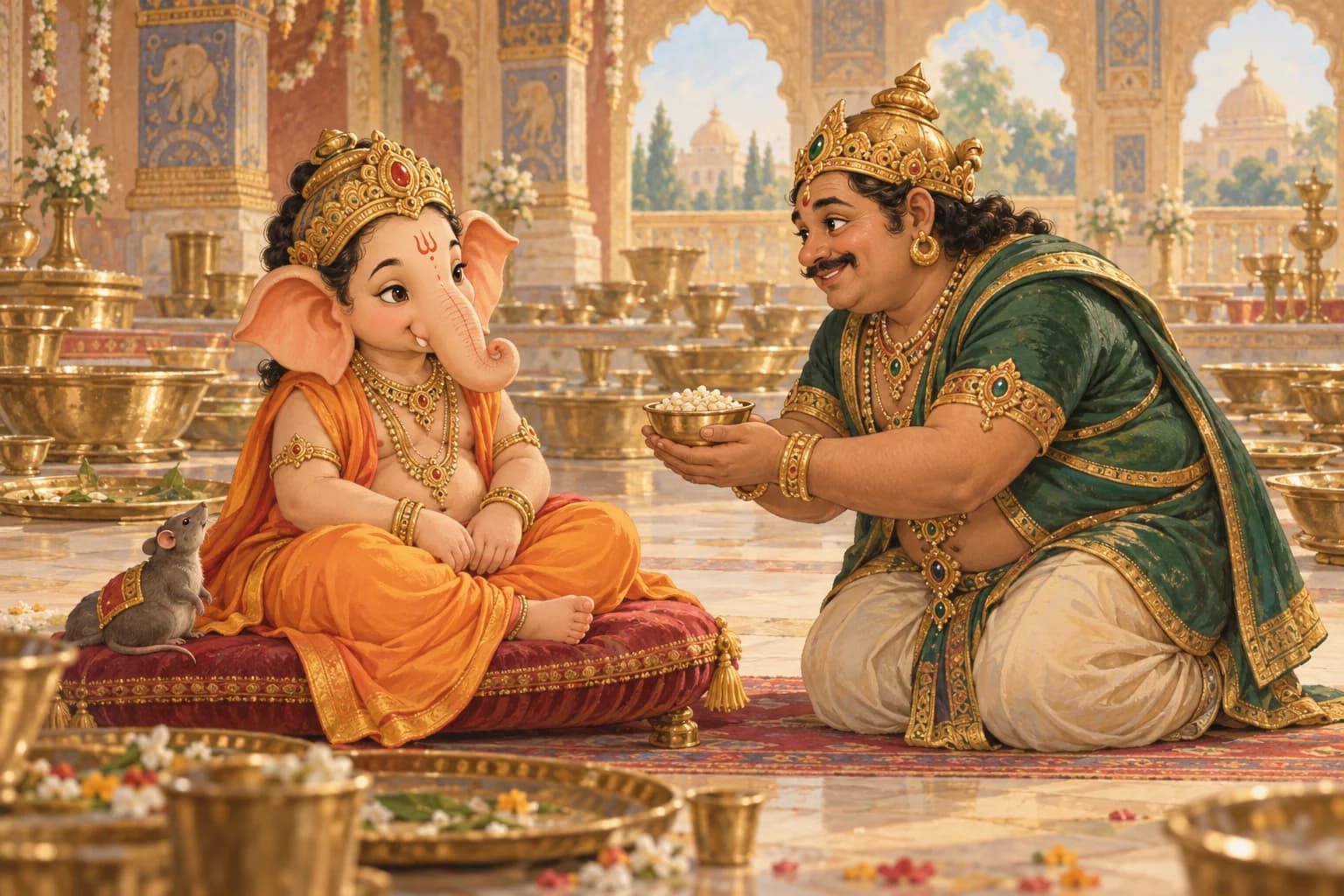
When Ganesha arrived, Kubera welcomed him into the palace. It was the moment he had prepared for. A fine feast, a splendid setting, a guest ready to be impressed: surely everything was in place. Ganesha, however, was hungry. He was ready to eat, and the first dishes were brought before him.
Still hungry
Ganesha ate what was served and asked for more. Kubera was happy to provide it. More food was a chance to show more abundance. But another serving disappeared, and Ganesha was hungry still. Food kept arriving; empty dishes kept returning. What had begun as a proud display was becoming a problem Kubera had not expected.
The supply that had seemed so generous began to run out. Kubera could not solve this simply by pointing to another treasure or admiring another fine part of his palace. His guest’s hunger remained. For the first time, his thoughts moved away from how impressive the feast looked and towards the person he had promised to care for.
At last, Kubera went to Shiva for help. He had believed his wealth would be enough for any demand. Now he had to admit that it was not enough here. Asking for guidance meant putting down the confident picture he had made of himself: the host who always had more than anyone could possibly need.
A different kind of offering
Shiva directed him towards a different kind of offering—simple food given with humility and devotion. The change was not just in the size of the serving. Kubera needed to change the spirit in which he offered it. Was he feeding his guest with care, or using his guest as an audience for his riches?
Kubera returned to Ganesha. In the version told here, he brought a small offering of roasted rice. This time he was not trying to prove that his palace was the grandest or his stores the fullest. He offered it sincerely. Ganesha accepted the food, and at last his hunger was satisfied.
The feast had taught Kubera something he had not planned to learn. Beautiful things and plentiful food could be enjoyed, but they could not take the place of attention and kindness. At the beginning, he had wanted his guest to notice the host. By the end, he had learned to notice his guest.