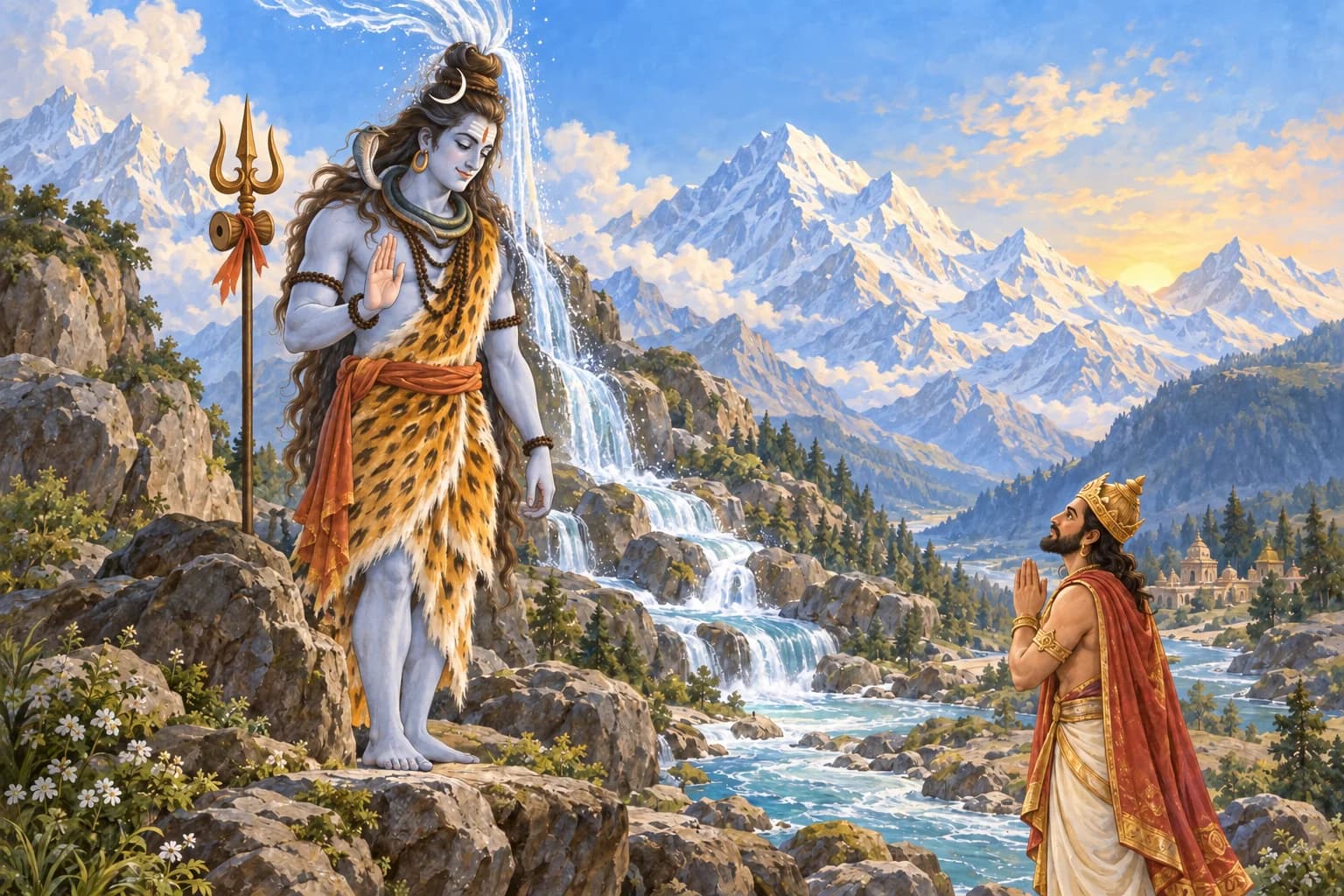
How did Ganga Descend to Earth | Story of Ganga, Shiva and Bhagirath
Video by: The Eternal Epics
Video language: EnglishLength: 1:06
Before you watch
A brief English explanation of Bhagiratha seeking Ganga’s descent and Shiv Ji receiving her force. It mentions the death of 60,000 ancestors and describes a curse by Kapila; preview this reference if death worries your child. Brahma’s role follows a Ramayana-style telling, while our reading follows the Bhagavata account, which does not attribute the deaths to Kapila’s anger. The story is compressed and the captions mishear names. The publisher discloses AI-made visuals or sound; these are illustrated interpretations. Includes channel promotion and end-screen suggestions.
Selection checked: 2026-09-18. Complete available English captions, comparison with Valmiki Ramayana Bala Kanda 42–43 and Bhagavata Purana 9.8.12 and 9.9, and sampled scenes; not a full audiovisual or age-certification review.
Hearing another language?
YouTube may choose a dubbed track. Open Settings in the video player, then Audio track, and choose the language selected above. We review each listed language separately.
Read together
A hope carried forward
King Bhagiratha carried a hope that had begun before his own lifetime. His ancestors needed the sacred waters of Ganga. Earlier members of his family had tried to bring the river to Earth without succeeding. Bhagiratha took up that unfinished effort with devotion, seeking a blessing for those who had come before him.
At last Ganga appeared and invited him to make his request. Bhagiratha bowed and explained what he hoped for. But the river’s arrival was not a small thing to arrange. A wish could name the destination without solving the difficulties along the way. Ganga asked him to think about what her descent would require.
The river’s question
Her waters would fall with tremendous force. Who could receive them? If nothing sustained that descent, the force would drive the river through the earth. In the sacred account, Ganga also asked how she would be freed of the burden left by those seeking purification in her waters. Bhagiratha needed to respond to the river’s concerns as well as his own hope.
He spoke of holy devotees whose presence would answer the spiritual burden she described. For the force of the water, he looked to Shiva. Shiva could sustain the river upon his head. Bhagiratha’s determination now had a new task: he would seek the help that could make the descent possible.
Bhagiratha turned to Shiva with devotion and made his request. Shiva agreed to receive Ganga. He took the powerful waters upon his head with care. The great strength in this scene was not used to win a contest. It supported a journey that could not safely begin in the way Bhagiratha had first hoped without help.
A journey made possible
Then Bhagiratha went ahead in his chariot, and Ganga followed him across the land. The long effort had become a moving river. The Bhagavata describes her waters reaching the ashes of his forefathers and bringing them spiritual release. Bhagiratha’s hope for his ancestors was fulfilled through his devotion, Ganga’s descent and Shiva’s help.
The story brings several kinds of action together. Bhagiratha persists, Ganga asks what is needed, and Shiva offers the strength to support her arrival. None of these parts can be replaced by simply wishing harder. A great undertaking becomes possible when its real difficulties are heard and the needed help is found.
Today, families may remember Shiva holding Ganga when they see her flowing from his hair in a picture. Beyond the sacred story, real rivers also sustain plants, animals and communities. We can honour that connection through ordinary care for water, while keeping the story’s spiritual meaning distinct from a lesson about how rivers physically form.
Let’s talk about it
Why was Ganga’s question important to Bhagiratha’s plan?
One more question
Which people, plants or animals depend on water near your home?
Which people, plants or animals depend on water near your home?
A little wisdom to keep: Determination grows more useful when we listen and find the right support.
Draw a river of connections · 5 minutes
Draw a river across a sheet of paper and leave room on both banks.
Add people, plants and animals that need the river.
Choose one everyday way your family can avoid wasting water or putting rubbish into drains.
Draw that action beside the river and explain whom it could help.
A note for grown-ups
The narrative briefly mentions ancestors’ ashes and spiritual release without describing their deaths. Purification here is a religious idea; it does not mean river water is safe to drink. The activity needs paper, not a visit to water or any change to your family’s religious practice.
Sources & tradition
Original retelling of Bhagavata Purana 9.9.2–12. This version includes Ganga’s concerns, Bhagiratha’s request to Shiva, Shiva receiving the waters and their journey to the ancestors. The familiar hair imagery appears in devotional art; the linked passage describes Shiva sustaining Ganga on his head. The Ramayana’s longer descent account has additional episodes that are not mixed into this telling. River care is our present-day reflection.